
Discussions about the future of procurement often place AI, automation and analytics in the same sentence. They solve different problems. A language model may interpret a messy description; an API moves records; a report presents calculated results. A useful investment starts by separating these jobs and identifying the bottleneck that matters.
AI can change preparation work
Interpreting an Excel item list, identifying missing descriptions and drafting sourcing instructions are concrete starting points. Guessing a product code, unit or supplier identity can create a commercial error, however. Checks against system records and human review should remain part of the workflow.
NIST's generative AI profile addresses risks specific to these systems. A practical procurement response is to define which outputs remain drafts and who checks them, rather than asking AI to handle everything. Publishing an event and choosing a supplier are decisions that need explicit ownership.
Connected tools matter alongside individual applications
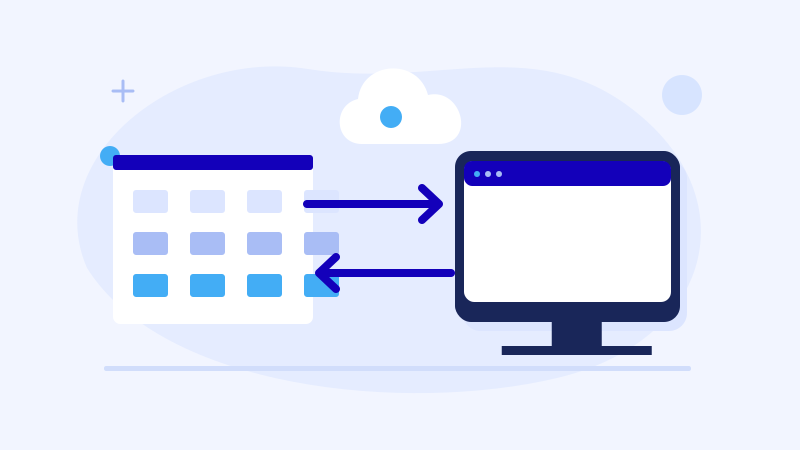
Organisations may use an ERP, a procurement platform and several analytical tools at the same time. Innovation therefore includes moving information reliably between systems, not just bringing every activity onto one screen. Connecting a requisition to its sourcing result is a concrete way to reduce repeated data entry.
MCP provides a common structure for communication between AI applications, tools and data sources. Tenflex AI Connect follows a model-independent approach: users can prepare Tenflex operations through a compatible AI environment they choose. They need to understand the service involved and the permissions granted. The third-party AI provider's data processing terms still apply.
Data quality becomes harder to ignore
Different descriptions for the same material or duplicate codes for the same supplier limit the usefulness of new tools. Processing poor records more quickly does not improve them. Data ownership, unit mapping and current supplier contacts belong in the preparation for a technology project.
A first exercise might review the hundred most frequently used items. Which descriptions cause confusion? Which units are missing? Which supplier records are duplicates? These questions often produce more immediately useful work than a broad meeting about an AI strategy. Assign ownership of corrections so the cleaned dataset does not gradually return to its previous condition.
Sustainability needs usable questions
If energy use, maintenance or packaging affects the purchasing decision, request comparable evidence. ISO 20400 provides guidance on integrating sustainability into procurement. A practical starting point is a small number of category-specific questions with answers that can be checked. A general “environmentally friendly” statement should not be treated as a measured result.
Consider who will review the information and how it affects the award decision. Collecting sustainability documents without a defined use creates another folder, not a better purchasing process. The questions should be proportionate to the item being purchased and the decision being made.
How to evaluate the next investment
For each technology, write down the expected output, required data, reviewer and success measure. Run a limited trial first. If draft preparation becomes faster while correction work increases, report both effects rather than presenting only the speed improvement.
Use this framework to evaluate Tenflex's connected requisition, quotation, auction and order processes, as well as AI Connect. The aim is to give buyers better-prepared decisions with less repetitive work. If a technical capability cannot be connected to a clear operational need, reconsider the scope before expanding the investment.